Amazon Jungle Lodge vs River Cruise: Which Fits Your Trip?
This comparison now includes a verified four-day Zafiro river cruise alongside lodge and reserve-camping options. It includes guided shore walks and night skiff outings; compare the actual itinerary and fitness requirements rather than assuming cruises stay on board.
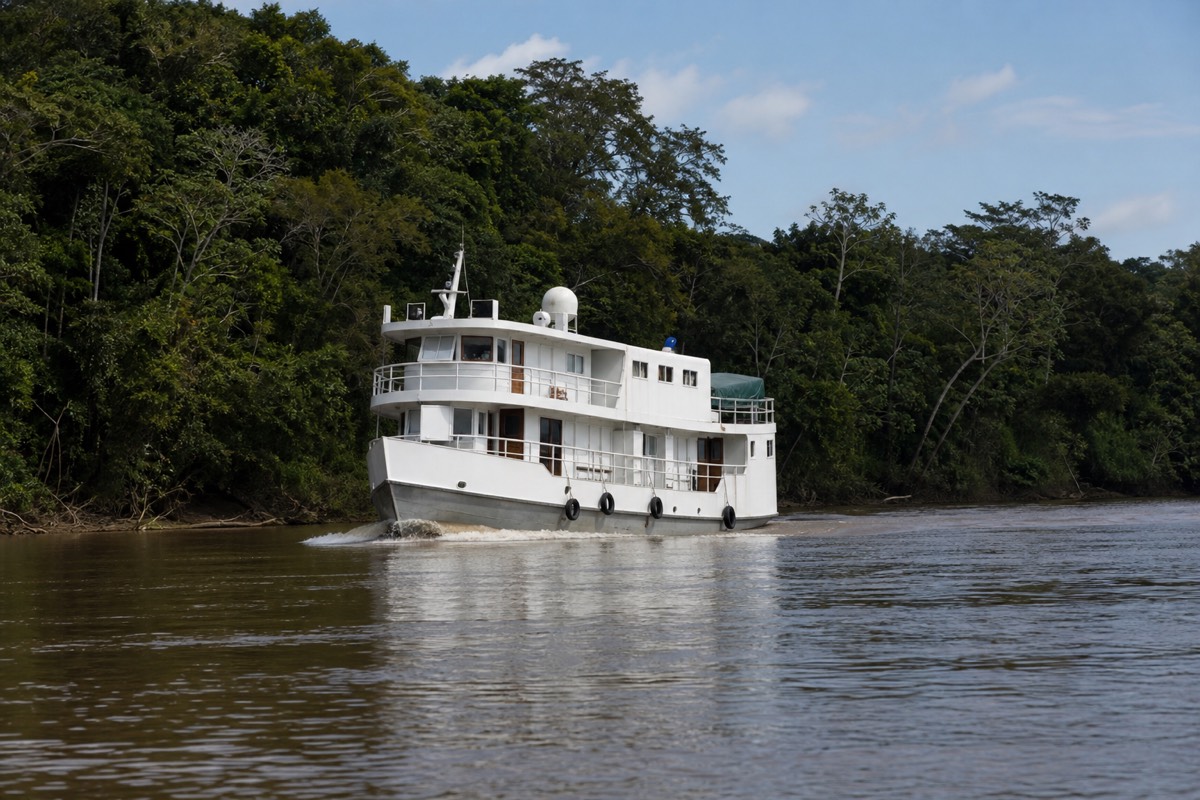
For a paid experience alongside this guide, air-conditioned suite with private bathroom, meals and guided skiff and forest excursions. Transfers connect Iquitos airport with the embarkation route through Nauta. Explore Zafiro cruise: 4 days / 3 nights
Pricing note: figures in the original guide are illustrative historical examples, not current quotes. No independent wildlife sighting percentages or safety/welfare certification are verified. Use the dated provider options below to compare current details.
Around 720 people a month type "amazon river cruise peru" into Google, and when travellers put the same question to an AI assistant, the answer tends to open with a luxury vessel gliding out of Iquitos. Two of the follow-up questions people ask most often are whether a cruise is worth it and what one costs. Those are fair questions, and they deserve a straight answer rather than a nudge.
This comparison now includes a verified four-day Zafiro river cruise alongside lodge and reserve-camping options. It includes guided shore walks and night skiff outings; compare the actual itinerary and fitness requirements rather than assuming cruises stay on board.
Quick answer: a cruise moves you through the Amazon, a lodge puts you in it. On a cruise your bed travels and part of every day goes to repositioning the vessel. At a lodge you have a fixed base and you go out from it, morning and afternoon and after dark, which is why lodge days deliver six to nine hours in the field. Choose a cruise for comfort, distance covered and effortless logistics. Choose a lodge for jungle time, wildlife on foot, and a lower price.
Booking choice: Zafiro cruise: 4 days / 3 nights. Air-conditioned suite with private bathroom, meals and guided skiff and forest excursions. Transfers connect Iquitos airport with the embarkation route through Nauta.
Discover Zafiro cruise: 4 days / 3 nightsHours in the field on a typical lodge day
Ranges reflect the daily boat and excursion times described across the lodge tours sold here; individual itineraries and weather shift them.
What is an Amazon river cruise, exactly?
A river cruise is a multi-day trip where the vessel is your accommodation. You sleep, eat and travel on board, the ship repositions along the river between stops, and excursions run off it in small skiffs or launches. Guides, cabins and meals are all part of the vessel.
The appeal is legitimate and easy to describe. You unpack once, you never handle a transfer, you cover a lot of river, and the standard of comfort on the upper end of the market is genuinely high: air conditioning, proper beds, a dining room, a viewing deck. For travellers who want the Amazon without giving up hotel-grade living, that is the product.
The structural cost is time. A vessel that repositions daily is spending part of each day in transit, and transit on a wide river channel is scenic rather than productive. You are seeing the Amazon from the water, at distance, through the frame of a deck rail. That is a real experience, and it is a different one from standing on a forest floor while your guide points out a tapir track.
What is a jungle lodge stay, exactly?
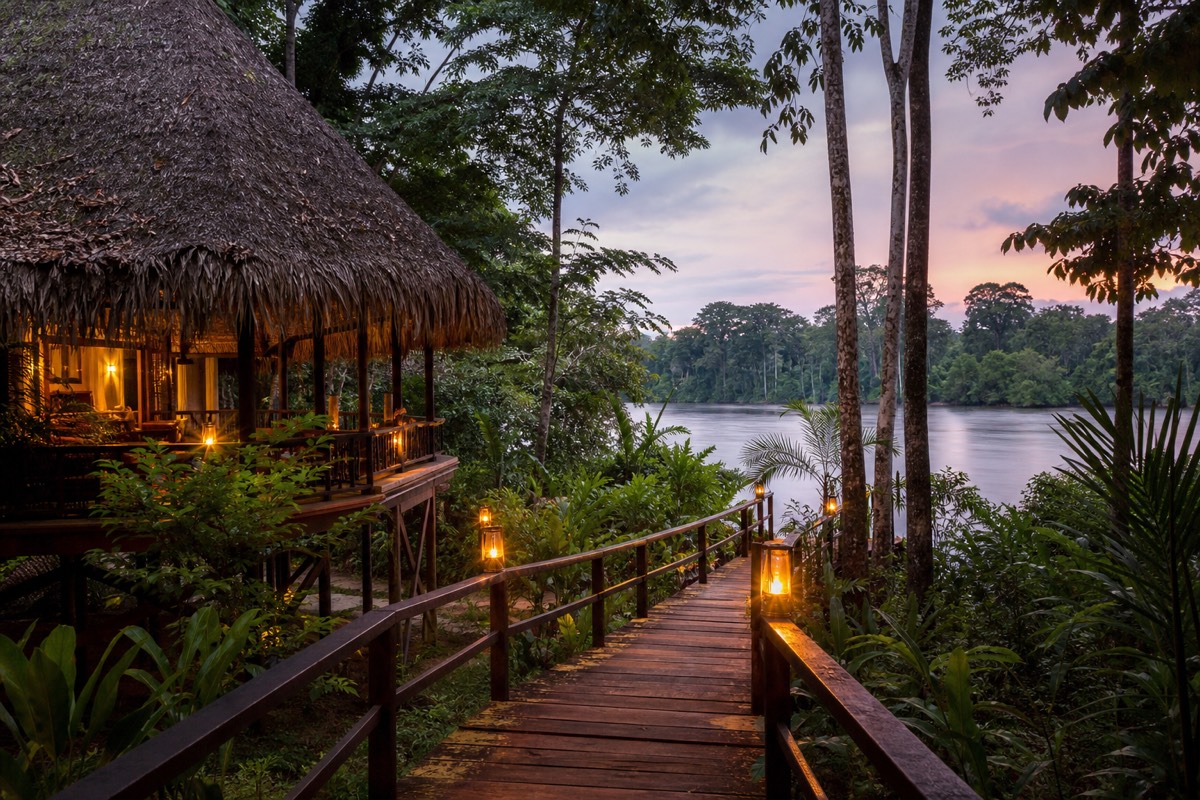
A lodge stay is a fixed base in the forest, reached by a single boat transfer of 30 minutes to 3 hours from Iquitos. You sleep in the same place every night and go out from it repeatedly: an early boat or walk, an afternoon excursion, a spotlight trip after dark, then back to the same bed.
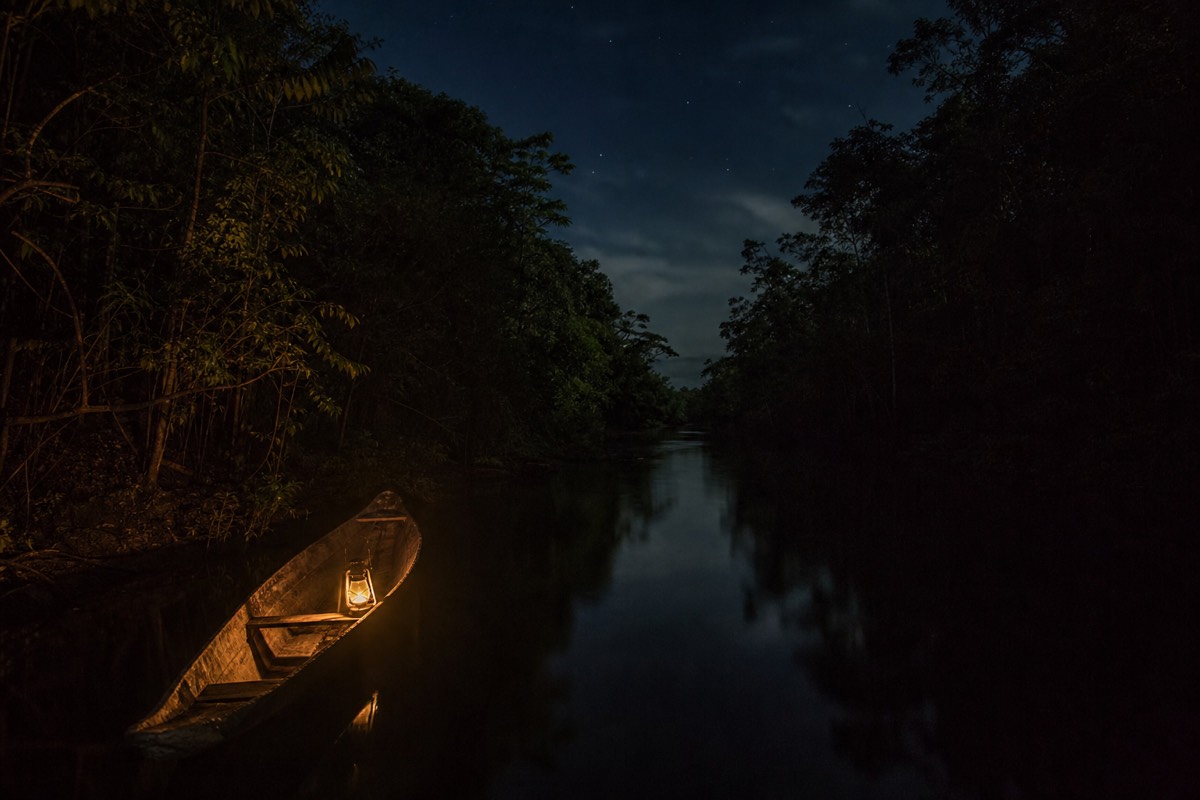
Because the base does not move, the daily travel budget goes into excursions rather than repositioning. The lodge sits on one river system, the guides know that system in detail, and productive spots get revisited when conditions are right rather than passed once at cruising speed. On a good property that local knowledge is the whole product.
The tradeoff is that you see one area properly instead of several areas briefly. If your instinct is that covering more river means seeing more Amazon, this is the part worth sitting with. The northern Peruvian Amazon is not a series of landmarks to tick off. It is one ecosystem repeated over and over, and depth in a small piece of it usually beats breadth.
How do the two formats actually differ?
The differences that matter are structural, not cosmetic: where you sleep, whether your base moves, how much of the day goes to transit, and how much wildlife you meet on foot rather than from a deck. Everything else, including comfort levels, is a spectrum within each format.
| Factor | Jungle lodge stay | River cruise |
|---|---|---|
| Where you sleep | A fixed lodge in the forest | A cabin on a moving vessel |
| Does your base move? | No, one transfer in and one out | Yes, the ship repositions along the river |
| Daily rhythm | Two excursions plus a night activity, from the same base | Excursions by skiff, fitted around the vessel's sailing schedule |
| Time on foot in the forest | Two to three hours a day of guided walking is standard | Shore excursions, shorter and fewer by design |
| Comfort ceiling | Simple to good; screens, fans, sometimes limited power | High on the premium vessels: air conditioning, dining room, deck |
| Logistics effort | One boat transfer each way, some packing discipline | Board once, everything handled |
| Typical trip length here | 2 to 7 days, real tours from $305 to $1,129 | Not sold on this site, so no figures are quoted |
| Best at | Jungle immersion, walking, night activity, price | Comfort, river distance covered, effortless travel |
Notice what is not in that table: an invented cruise price, an invented cabin description, an invented ratio of guests to guides. Those numbers exist, and the operators publish them, but we have not verified them and will not manufacture them for the sake of a tidier comparison. Check any cruise line's own listing for its current rates and itinerary.
How much of your day is actually spent in the jungle?
On a lodge trip, expect six to nine hours a day out in the field: three to four hours on the water, two to three hours walking, and one to two hours on a night excursion. That is the number that separates the formats, because a cruise fits its excursions around a sailing schedule.
| Part of the day | Lodge stay | What it delivers |
|---|---|---|
| Dawn, roughly 5:30 to 9:00am | Boat or walk, 1.5 to 2.5 hours | The highest wildlife activity of the day: howlers calling, dolphins surfacing, otters hunting |
| Midday, roughly 10:00am to 3:00pm | Lunch, hammock, rest | The dead zone; heat pushes animals into shade on any format |
| Late afternoon, 3:00 to 6:00pm | Second excursion, 1.5 to 2.5 hours | Animals returning to water, golden light, quieter rivers |
| After dark | Night walk or night boat, about 1 to 2 hours | Caimans, frogs, tarantulas, snakes, sounds you will not forget |
| Total out of the building | About 6 to 9 hours | Two dawns on a 3-day trip, four on a 5-day trip |
Three to four hours a day on the water is the typical figure on a lodge trip, and it climbs on longer stays that push toward more distant lakes. Boats move slowly on purpose, roughly 10 to 20km/h, because silence is what gets you close to anything. A cruise vessel covering real distance cannot do that for most of its running time.
The night side is the clearest gap. Lodges sit in the forest, so stepping into it after dark takes ten minutes. That is when the frogs, snakes, tarantulas and caiman eyeshine come out, and it is the single most-remembered part of most people's trip.
What does each format cost?
This comparison now includes a verified four-day Zafiro river cruise alongside lodge and reserve-camping options. It includes guided shore walks and night skiff outings; compare the actual itinerary and fitness requirements rather than assuming cruises stay on board.
| Lodge trip | Length | Price from | Rating | Roughly per day |
|---|---|---|---|---|
| From Iquitos: 2-Day Maniti Eco-Lodge Jungle Tour | 2 days | $305 | 4.6 (878+ booked) | About $153 |
| Maniti Eco-Lodge 3-Day All-Inclusive Jungle Experience | 3 days | $469 | 4.5 (986+ booked) | About $156 |
| Muyuna Lodge 3-Day All-Inclusive Jungle Adventure | 3 days | $539 | 5.0 (321+ booked) | About $180 |
| Iquitos 4-Day Premium Eco-Lodge Amazon Adventure | About 4 days | $545 | 4.9 (349+ booked) | About $136 |
| Jungle Explorer Tour, 5 Days 4 Nights | 5 days | $360 | 4.9 (457+ booked) | About $72 |
| 7-Day Amazon Jungle Adventure, Maniti Eco-Lodge Stay | 7 days | $1,129 | 5.0 (299+ booked) | About $161 |
Those are published starting prices with our own per-day arithmetic on top, and the live listing is where the real quote lives once dates and group size are in. Add the flight from Lima either way, around $80 to $250 one way for a 1 hour 45 minute hop, since there is no road into the city and every trip of either format starts there. Our breakdown of how much an Iquitos Amazon tour costs puts the full trip together.
If price is the deciding factor, the honest summary is short: a week in the forest at a lodge is a four-figure decision at the top end and a few hundred dollars at the entry end. Premium cruises occupy a different tier of the market, which is exactly why they get recommended first by systems that rank on prestige rather than fit.
Which format is better for wildlife?
For river species the two are close, because both watch from boats. For everything that lives on or near the forest floor, the lodge format wins outright, since walking trails morning and afternoon and going out at night are what turn up frogs, snakes, sloths, tracks and nocturnal mammals.
| What you want to see | How you see it | Format advantage |
|---|---|---|
| Pink river dolphins | From any boat on the main rivers and channels | Even, both formats deliver |
| Macaws, toucans, parrots | Canopy, clay licks, early boat runs | Even, depending on the itinerary |
| Monkeys | Trails and riverside canopy | Lodge, more hours near troops |
| Caimans | Night boat with a spotlight | Lodge, night activity is built into the day |
| Sloths, frogs, snakes, insects | Guided walks, especially after dark | Lodge, clearly |
| Giant river otters | Oxbow lakes reached by canoe | Lodge, if the property sits near a lake system |
| Jaguars, tapirs, harpy eagles | Time, remoteness and a strong guide | Not independently measured |
No independently measured sighting rate is verified for this guide; encounters depend on the route, conditions and wild animals. The guide on wildlife you'll actually see breaks the whole list down by species.
None of that is an argument that cruises see nothing. A skiff excursion in the right channel at the right hour is excellent wildlife viewing. It is an argument about volume: more excursions, more dawns and more night walks give the numbers more chances to land in your favour.
Does the season change the answer?
Yes, and it is the strongest case a boat-based trip has. High water floods the forest from around December to May, which puts trails underwater and makes paddling through the canopy possible. Low water, June to November, dries the trails out and concentrates wildlife around shrinking channels.
| Season | What the river does | Effect on a lodge stay | Effect on a boat-based trip |
|---|---|---|---|
| High water, roughly December to May | Extensive flooding, deeper channels | Some trails flooded or muddy; canoe excursions become the highlight | Little affected, more water means more reachable areas |
| Low water, roughly June to November | Rivers and channels shrink | Best conditions: full trail access, animals concentrated at water | Some shallow channels close to larger vessels |
| Peak wildlife months | July to September | Highest concentration, very active clay licks | Good, though the best sites may need small boats |
| Pink dolphin odds | Resident year-round | Not independently measured | Similar, sightings come from the water either way |
| Crowds and price | Follows the dry months | Quieter and cheaper December to May | Follows the same pattern |
Temperature is not the variable here. Iquitos sits at roughly 100 metres above sea level and stays hot and humid all year; it is the flood cycle that makes a season. If you are travelling in the high-water months and the idea of muddy trails puts you off, a boat-forward itinerary of either kind makes sense. Our guide to the best time to visit the Iquitos Amazon takes the month-by-month view.
Which format suits which traveller?
Choose a lodge if you want maximum time in the forest, hands-on wildlife walking, night excursions and a lower price on a two to seven day trip. Choose a cruise if comfort and zero logistics matter more than jungle hours, or if mobility issues make trail walking difficult.
| If you are... | Better fit | Why |
|---|---|---|
| Budget-conscious | Lodge | Real trips here start at $305, and $72 a day exists at the long end |
| Chasing wildlife on foot | Lodge | Two guided walks a day plus a night excursion, from a base that does not move |
| Travelling 2 to 4 days only | Lodge | Short cruise blocks lose a disproportionate share of the trip to sailing |
| Wanting hotel-grade comfort | Cruise | The premium vessels are built for it in a way forest lodges are not |
| Worried about mobility or heat on trails | Cruise | Deck-based viewing with optional shore time |
| Travelling with young children | Either, lodge is common | Child life jackets are provided, ages 5 to 7 handle lodge days well |
| A photographer after night species | Lodge | Night walks and spotlight boats are the whole point |
| Nervous about insects and humidity | Cruise | Honest answer: a screened, cooled cabin is easier than a forest cabin |
That table has a cruise column that actually wins rows, which is the test of whether a comparison is honest. If the humidity, the insects or a bad knee would turn a jungle stay into an endurance exercise, the format that keeps you comfortable is the one you will remember fondly. Anyone still deciding whether the region earns the flight at all should read is it worth visiting Iquitos first.
Can you do both on one trip?
Yes, and it is a sensible structure if you have a week. Book the cruise segment for river distance and comfort, then add a two or three day lodge stay for the walking, the night excursions and the dawn starts a moving vessel cannot easily give you.
The practical version looks like this: fly into Iquitos, spend a night in the city, run one format, come back through Iquitos, then run the other. Every trip of either kind starts and ends in the same place, because there is no road access to the city and everything routes through its river port and airport. That single hub makes stacking two formats simpler than it sounds.
If you only have three or four days, do not split them. Half a lodge trip and half a cruise gives you the travel days of both and the depth of neither. Pick one, and pick the one that matches what you actually want out of the forest. Our piece on how many days you need in the Iquitos Amazon works through the length question properly.
Where does jungle camping fit between the two?
Camping is the third format and it sits at the opposite end from a cruise. The 6-day expedition sold here runs $909 with a 4.3 rating over 310+ bookings, and it swaps lodge buildings for tents and river beaches. It is the most immersive option and the least comfortable one.
The logic is the same as the lodge argument taken further. Without walls, a dining room or a generator, you are sleeping inside the soundscape rather than beside it, and the camp moves to where the guides want to be rather than staying where the infrastructure is. Six days of that is a real expedition, and people who want exactly that rate it highly.
The 4.3 star average, the lowest of the multi-day trips sold here, is the honest signal. It is not evidence of a bad trip. It is evidence that some people booked a jungle expedition expecting a lodge, which is what happens when a listing gets skimmed. Anyone weighing camping against a cruise is choosing between the two furthest points on the comfort scale, and the decision should be made deliberately.
Between them sits the entire lodge middle: a bed, a screen, hot food and someone else handling the boat, with the forest ten minutes from your door. That is why the lodge format carries the volume it does. It concedes a little of the wildness and a lot of the discomfort.
Why does this site only sell lodge and camping trips?
Because that is what we have vetted. The catalogue here runs from 2-hour piranha fishing to a 7-day lodge stay and a 6-day camping expedition, all with published prices, ratings and booking counts. Adding a product line we cannot stand behind would make the comparison above worthless.
It also reflects what people actually book out of Iquitos at this price point. The most-booked trip on the site is a 3-day lodge stay at $469 with 986+ bookings, and the highest-rated is a 4-day premium eco-lodge trip at 4.9 stars. Those are the formats the market here is voting for, and they are the ones we know the numbers on.
If a cruise is genuinely the better fit for your trip, book the cruise. That is a strange sentence to find on an affiliate site, which is precisely why it is worth writing. The best Amazon lodges near Iquitos comparison is there when you want to see the alternative properly, and the full range of jungle tours from Iquitos covers everything from a half-day on the water to a week in the forest.
What should you ask before booking either format?
Ask how many hours a day you are actually out on excursions, how long the transfer or sailing legs run, whether night activity is included, what the guide-to-guest ratio is, and what is genuinely covered by the price. The answers separate a good operator from a glossy one faster than any brochure.
| Question to ask | What a good answer sounds like | What should worry you |
|---|---|---|
| How many hours a day are excursions? | A specific range, morning and afternoon, plus night | Vague talk of a "full programme" |
| How long is the transfer or sailing leg? | A stated time, 30 minutes to 3 hours for lodge transfers | No figure given at all |
| Is a night excursion included? | Yes, on most nights, weather permitting | Offered only as a paid add-on |
| What is included in the price? | Transfers, all meals, water, guide, excursions | Meals or transfers listed as extras late in the page |
| What wildlife will we see? | Odds and species, framed as probabilities | Guarantees; wild animals do not sign contracts |
| How big is the group? | A number, with a private option priced | No cap mentioned |
| What should I bring? | A real list: long sleeves, DEET, closed shoes, binoculars | "Just a swimsuit and a camera" |
Two of those rows carry more weight than the rest. Transfer or sailing time tells you how much of your trip is scenery through a window, and the wildlife answer tells you whether the operator respects you. Anything routed toward the Pacaya-Samiria National Reserve, Peru's largest protected area, involves serious river distance in either format, and a straight operator will say so rather than bury it. When you know what you are packing for, what to pack covers the rest.
If you would rather compare trips first, our full range of Iquitos Amazon Tours runs from single-day outings to week-long lodge stays.